
How to decide how many weeks to fill your pill organizer for
These are tips from my own experience as a caregiver – not medical advice. I'm not a healthcare professional. Always follow your pharmacist's or doctor's instructions for any medication.
Most people fill their pill organizer once a week. It's the default – most organizers are sold as "7-day" organizers, most advice says weekly, and so weekly becomes the habit.
From my experience, weekly is often the wrong choice – or at least not the only choice worth considering. I fill my mom's pill organizer for four weeks at a time whenever I can, and it's made the whole process significantly less stressful. But four weeks isn't right for everyone, and there are real reasons you might choose one, two, or three weeks instead.
Here's how to think about it.
The case for filling less often
Every time you fill a pill organizer, you're spending focused time and mental energy on a task that has real consequences if you get it wrong. The fewer times you do it, the less total stress it generates – and the less opportunity there is for errors.
From my experience, the sweet spot for most people managing medications for a family member is two to four weeks. You do it less often, you can stock up on medications further in advance, and you spend more of your visits doing things that actually matter rather than sorting pills.
With supports filling the pill organizer for one to four weeks and works out exactly how much of each medication goes into each slot – so the math doesn't get harder the more weeks you choose.
With does the math for you. Tell it how many weeks you're filling the pill organizer for – it works out exactly how much of each medication to put in.
When four weeks makes sense
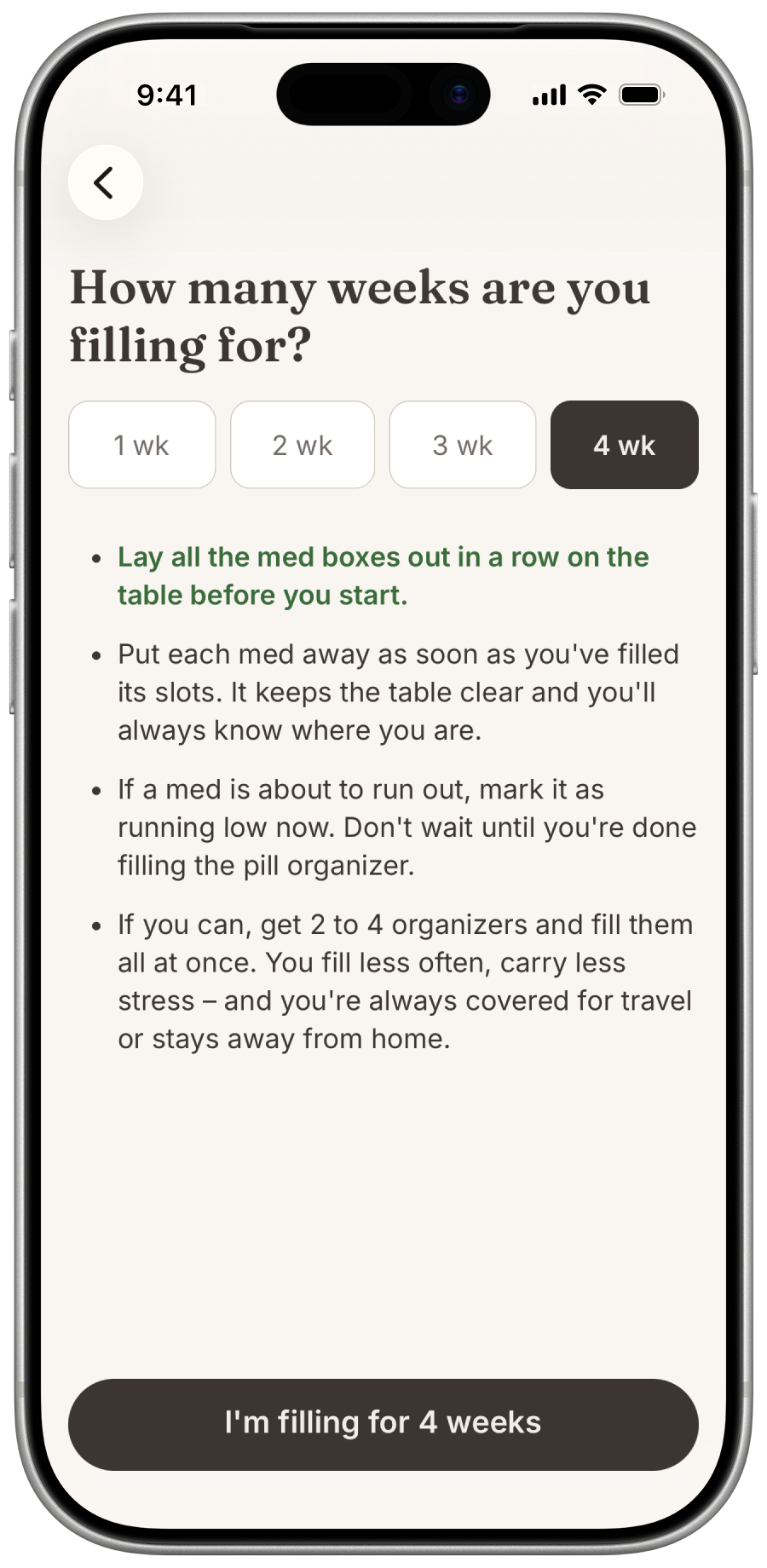
Four weeks is my personal recommendation if your situation allows it. Here's when it works well:
You're filling for someone else and visiting periodically. If you travel to fill the organizer rather than living with the person, four weeks means one visit per month dedicated to medications instead of four. That's a significant difference in time, logistics, and mental load.
The medication list is stable. If doses and medications aren't changing frequently, you can confidently fill four weeks knowing the list will still be accurate at week four.
You can get medications in sufficient quantity. Some medications are dispensed in 30-day supplies, which aligns naturally with a four-week fill. Others may be harder to stock in large quantities – check with your pharmacist.
The organizer has enough compartments. A standard 7-day organizer holds one week. For four weeks you need four of them, or a larger organizer designed for monthly use.
When two or three weeks makes more sense
Medications change frequently. If doses are being adjusted or new medications are being added regularly, filling four weeks means potentially having to redo part of the organizer when something changes. Two weeks gives you a shorter window of exposure. And whenever a dose or medication changes, update your list immediately and refill the affected compartments – never assume the old fill is still correct. If you're unsure about any change, your pharmacist or doctor is the right person to ask.
Supply is limited. Some medications are only dispensed weekly or fortnightly. Fill for as many weeks as your supply allows.
It's your first time setting up the system. Start with two weeks. Get comfortable with the process, verify everything is correct, then extend to four weeks once you're confident.
When one week is the right answer
One week isn't wrong – it's sometimes the only practical option. If medications change very frequently, if supply is genuinely limited to weekly quantities, or if the person filling the organizer doesn't have the time or capacity to do more, weekly is fine. The goal is a system you actually follow, not an ideal you can't sustain.
The one thing that makes any duration easier
Whichever duration you choose, the thing that makes it actually work is knowing the math in advance – how many of each medication you need for the number of weeks you're filling. For a single medication taken once a day, that's simple. For eight medications with different doses, different days, and different times of day, it's genuinely complex.
With handles this calculation for you. Tell it how many weeks you're filling the pill organizer for, and it tells you exactly how much of each medication goes into each slot. Change the number of weeks and it recalculates immediately. No spreadsheet, no mental arithmetic, no second-guessing.
